February 3, 2026
Marketing
Strategy
Branding
Time to Read:
5 minutes
Author:
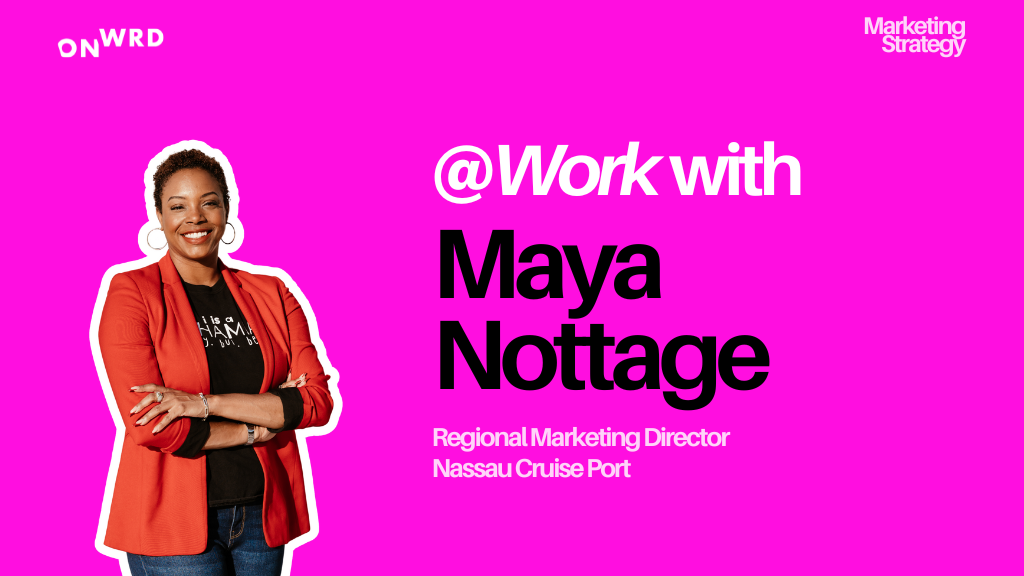
Nassau Cruise Port welcomed over 6 million passengers in 2025, making it one of the largest transit cruise ports in the world. Beyond serving as a global gateway for visitors, the port also supports a growing local audience that uses the space for dining, shopping, and events. In this edition of @Work, we spoke with Regional Marketing Director Maya Nottage about closing the gap between perception and reality, keeping the port authentically Bahamian, and turning a global visitor hub into a community space that Bahamians feel proud to claim. Their perspective highlights how destination marketing, local partnerships, and social impact all connect behind the scenes.
MN: One of our biggest challenges has been trying to bridge the gap between perception and reality for both our local and international audiences.
On the international side, people see headlines about record-breaking days with more than thirty thousand cruise passengers in port, and they assume Nassau is overcrowded, not exciting, and too busy. Through our marketing and communications, we work to show how fun, welcoming, and revitalised Nassau has become and what the experience at the port is really like.
For locals, the challenge is different. Before the $350M transformation, there was no public access to the port. It was a gate, a secure side and then the street. As part of the redevelopment, we created green space and event space so Bahamians and residents could actually enjoy the waterfront. A big part of our mission now is to communicate that this is not just “the port” in the old sense. It is our port.
Our tagline, “Your place to be,” comes from that goal. We want Bahamians to feel comfortable being here and to see the port as a place for them, not just a pass-through for guests. I would say we are closing that gap, but it is something we continue to work on every day.
MN: We want our community to feel like Nassau Cruise Port is a true destination for them, not just for visitors. That means thinking about how families, friends and locals can spend time here throughout the day.
When people come in, we want them to see that there is a lot for them to enjoy. There are new restaurants and a range of shopping options, from souvenirs for visitors to Bahamian owned luxury stores in the Port Plaza. Brands like House of Assembly, Bahama Hand Prints, Vida Cayo and Bahari are all here. When Bahari opened at the port, that was actually the biggest sales day they ever had, which shows the level of interest when people realise what is available.
We also think a lot about families. There are not many spaces where families can go to be outdoors, enjoy the harbourfront and have a nice meal together. Nassau Cruise Port can be that place. For us, it is about making sure that when Bahamians think about shopping, a day out or a family outing, the port comes to mind as a real option.
Our events are part of that. For example, our Christmas movie marathon on the amphitheatre green has become a favourite. People loved it, so we brought it back. It gives families another way to enjoy the space, and it reinforces the message that this is a place for the community.
MN: We lead with who we are. Nassau Cruise Port is a Bahamian company and we employ Bahamians, so our identity is not something we add on at the end. It is at the centre of how we tell our story.
A big part of that is centering local voices. We work with influencers like DasQuay and Timmay who are already trusted by local audiences and understand the culture. We highlight the Bahamian businesses on property, including the brands I mentioned, and we make space to feature the people of the port. These are not just brand stories. They are our stories as a community.
Today’s traveller is looking for something real and original. They want an experience that feels different. For me as a Bahamian, there is nothing more exciting than sharing my culture and my pride with our visitors. When we build campaigns around that authenticity, it resonates with both local and international audiences.
MN: For us, it always comes back to impact. We are not creating campaigns just to say that we did a campaign. We want to see real outcomes.
When we roll out a seasonal initiative like our “Your place to be” Christmas campaign with local influencers, we are focused on what that means for our tenants and partners. Are we driving more local traffic into the port so they can see their numbers go up? Are we seeing an increase in community engagement? Are our guests visiting more of the shops and restaurants?
We know our work affects tour excursions, downtown partners, and businesses in and around the port. So we look at data. We analyse visitor traffic and how people move in and around the port. We track attendance at events. On the digital side, we review metrics across Facebook, Instagram, and TikTok. We look at how many people are viewing, commenting, engaging, and sharing our content. When something resonates with key audiences, you see that level of engagement and sharing.
Feedback is just as important as the numbers. We conduct guest surveys every day. We survey after events and we use online surveys to understand how people feel about what we are doing. Social listening also plays a role. Many of us see the same cruise videos about Nassau that local audiences see in their feeds. Sometimes people send us content before we even find it because they want to know if something happened at the port.
We pay close attention to local sentiment. We want passengers to feel welcome and happy, but we also want our community to feel proud and to know that this is their space. All of that feedback helps us see what is working and where we need to adjust.
MN: I wish more people understood how collaborative it is. Nassau Cruise Port is much more than a physical space. It is a large, ongoing collaboration between internal teams and a wide network of external partners.
There is a lot of care that goes into building and maintaining a world class destination. And into 2026 we want to share more about that side of the work. We want people to see who is involved, how decisions are made, and how many different hands and minds contribute to the experience.
One of my favourite moments is when a Bahamian visits for the first time and says, “I did not know all of this was here, I am glad I have access, and I feel proud that this is the cruise port that welcomes almost six million passengers a year.” That sense of pride matters. These are our stories too, and helping people see their connection to the port is a big part of our job.
Access is central to that. Under our public-private partnership arrangement, there will never be a time when we say Bahamians cannot come in. Before we took over management, there was no public space for anyone. Now there is a waterfront area where people can work, do business, and simply enjoy being by the harbour.
I am proud to be part of a project that considers Bahamians in that way. We have created a place where people can build livelihoods and also slow down a bit. Most of us live close to the beach, but because of work and life, we do not always get to enjoy it. Being able to sit at the port, have a gelato or an ice cream, spend time with your kids or loved ones, and get some fresh air is a simple thing that makes a real difference. As a community, we can advocate for more of these kinds of spaces wherever we can create them.
MN: I do not know if everyone realizes that I am an autism mom. My daughter is high functioning, and that is a very important part of my life and my identity. In my own way, I see myself as an autism advocate. I would like to do even more personally to support people with autism and their families.
It is an underserved audience in many ways, but through organisations like REACH there is more work happening and more conversations taking place. The perceptions are starting to change. Conversations like this help, and I think we will see more progress over time.
From a cruise port perspective, that experience has definitely shaped how I think about accessibility and inclusion. One initiative I am proud of is introducing the Hidden Disabilities Sunflower program at Nassau Cruise Port. The program started in the United Kingdom and has been implemented in about two hundred airports around the world. We brought it here and, as far as I know, became the first cruise port on this side of the world to do so.
The program gives people with hidden disabilities, such as autism or chronic migraines, a discreet way to signal that they may need support. They can wear a sunflower symbol so that trained staff can recognise that they have a condition that is not visible and may need assistance. In some cases, they may not be able to speak or may be deaf, so the symbol opens the door for help.
For me, it comes back to the idea that people with hidden disabilities also travel and deserve to travel. If we can make it a little easier for them and their families to navigate the world, that makes life better for all of us. Travel is such a beautiful thing and no one should miss out on it.
Our parent company, Global Ports Holding, is now adopting the program at our thirty three ports around the world. The cruise lines themselves are also doing great work, from offering special headphones for children with sensory issues to providing quiet rooms with low lighting for those who need that environment. We are taking a page from their book and seeing how far we can help spread these practices throughout the cruise community.
On a broader level, this connects to the part of my role that I love most, which is corporate social responsibility. Yes, we care about business and economic outcomes, but we also have a responsibility to use our platforms to make our communities better socially and culturally. This is one of the ways we are doing that, and I am grateful that our leadership supported it wholeheartedly.
Maya’s perspective shows how destination marketing is about more than promotion. It is about shifting perceptions, opening access, listening closely to feedback, and building spaces that serve both visitors and the communities who live around them.
If your team needs support strengthening how you communicate place, experience, and impact, contact us to learn how ONWRD helps organisations align their marketing with what audiences value most.

March 3, 2026
Marketing
Comms
.png)
February 16, 2026
Marketing
Strategy